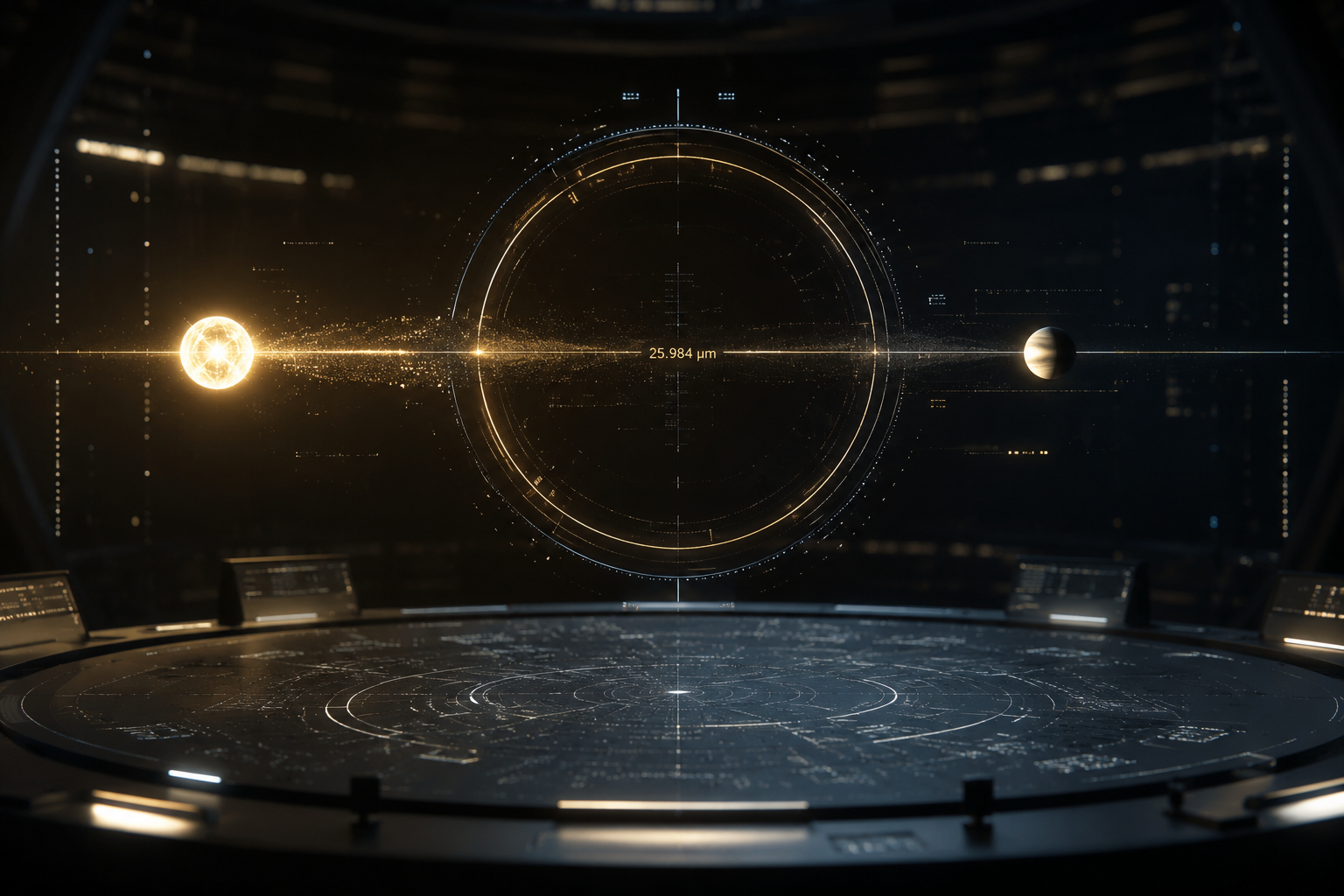
Directive 25.984 μm:
Addressing the Sol-Venus Problem
To whom it may concern,
I am writing to you to ask for help.
As one of the leading members in global science, politics, and engineering, your expertise is greatly needed in this dire time. I’m sure many of you are already aware, but for those who aren’t, I have attached an excerpt from Dr. ----- --------- recent email:
There is a very faint, but detectable line in the solar system that emits infrared light at the 25.984 micron wavelength. It seems to be solely that wavelength with no variance.
Attached are Excel spreadsheets with my data. I have also provided a few renders of the data as a 3-D model.
You will see on the model that the line is a lopsided arc that rises straight up from the sun's North Pole for 37 million kilometers. From there, it angles sharply down and away from the sun, toward Venus. After the arc's apex, the cloud widens like a funnel. At Venus, the arc's cross-section is as wide as the planet itself.
The infrared glow is very faint. I was only able to detect it at all because I was using extremely sensitive detection equipment while searching for IR emissions from nebulae.
After considerable further study, multiple researchers have independently verified the existence of this infrared band. However, this phenomenon cannot be adequately explained by our current knowledge of the solar system.
In an ideal scenario, this Sol-Venus wavelength will prove to be a harmless scientific wonder. But, under the potential threat of an unfamiliar occurrence in our very own solar system, it might prove necessary to err on the side of caution.
I urge your presence at a conference on Saturday, November ---- at 8 am to discuss this anomaly in further detail. Any suggestions or theories regarding this crisis are encouraged.
Sincerely,
—-------------
Crisis Directors

Kavya Chowti

Kliya Ashtekar
Rules and Procedure
This committee follows parliamentary procedure as defined in our Crisis Committee Parley Pro Document. However, procedure during committee may be modified at the Moderator’s discretion.
Position Paper
All delegates wishing to be considered for an award must submit a position paper before the start of conference. Position paper quality will be included in consideration of awards, however paper quality will not hold as much weight in award consideration as actual committee performance. Position papers are meant to ensure a basis for delegate research and help delegates feel confident while participating during the conference.
Detailed instructions for writing and submitting Position Papers can be found in the Position Paper Guidelines Document.
Questions
If you have questions about committee content or the format of your committee, please contact your Crisis Director at contact@ctmun.org with “The Sol-Venus Problem” in the subject line.
For questions about CTMUN conference and logistics, please contact contact@ctmun.org.